fusen
Reading 羅生門 in Japanese
A servant who has lost his place shelters from the rain under the ruined south gate of the capital and must choose between starving and stealing. At about 5,700 characters it can be read in one sitting, but its literary Japanese of 1915 is dense: a good second step after modern novels, not a first book.
Source: Aozora Bunko's text, the whole story. Counted on . How these numbers are counted
- Level
- Upper intermediateLevel 4 of 5 on this site’s scale
- Furigana
- On 13% of the kanji, mostly the rare onesAozora Bunko's edition, which follows its printed source
- Japanese
- Literary narration (〜である) with older spellings such as 云う; little dialogue
- Length
- About 5,700 characters, one sitting
- Read it in
- Free on 青空文庫 (Aozora Bunko) and カクヨム
How hard it is
The story is short, but nearly every sentence is long (35 characters on average) and literary. The setting adds words from the Heian period, such as 太刀, 市女笠 and 檜皮色; most of them appear once and can be skipped. The words that carry the story keep coming back: 下人, 老婆, 死骸, 梯子. With the 5,000 most common words known, about one word in seven is still new.
95%. Reading in another language becomes comfortable somewhere between 95% and 98% of words known (Hu and Nation, 2000).
| Title | Level | Known with 5,000 words |
|---|---|---|
| 葬送のフリーレン manga | — | |
| 魔女の宅急便 children's novel | — | |
| よつばと! manga | — | |
| 時々ボソッとロシア語でデレる隣のアーリャさん light novel | — | |
| 本好きの下剋上 light novel | — | |
| 無職転生 light novel | — | |
| SPY×FAMILY manga | — | |
| 羅生門 short story, 1915 | 86.5% | |
| 薬屋のひとりごと light novel | — | |
| Re:ゼロから始める異世界生活 light novel | — |
5,682 characters and 3,299 words in all: 733 different words, 459 of them used only once, and 498 different kanji. Sentences average 35.5 characters.
Words to know before you start
The words this story uses far more often than everyday Japanese, most frequent first. The first two are its only characters: the story never names them.
| Word | Reading | Meaning | Times |
|---|---|---|---|
| 下人 | げにん | low-rank person; menial | 44 |
| 老婆 | ろうば | old woman | 28 |
| 門 | もん | gate | 16 |
| 死骸 | しがい | (dead) body; corpse; carcass | 14 |
| 梯子 | はしご | ladder | 9 |
| 饑死 | うえじに | (death from) starvation; starving to death | 8 |
| 死人 | しにん | corpse; dead person | 8 |
| 髪の毛 | かみのけ | hair (on the head); (a) hair | 6 |
| 盗人 | ぬすびと | thief; robber | 5 |
| 楼 | ろう | tower; tall building; belvedere | 5 |
| 太刀 | たち | long sword (as opposed to the shorter katana) | 5 |
| 鴉 | からす | crow (Corvus spp.); raven | 5 |
18 more words
| Word | Reading | Meaning | Times |
|---|---|---|---|
| 勇気 | ゆうき | courage; bravery; valour | 5 |
| 段 | だん | step; stair; rung | 5 |
| 雨やみ | あまやみ | break in the rain | 4 |
| 頬 | ほお | cheek (of the face) | 4 |
| 着物 | きもの | kimono; Japanese traditional clothing (esp. full-length) | 4 |
| 面皰 | にきび | pimple; acne | 4 |
| 上る | のぼる | to ascend; to go up; to climb | 4 |
| 木片 | もくへん | block (of wood); chip; splinter | 3 |
| とぼす | とぼす | to light (a candle, lamp, etc.); to turn on (a light) | 3 |
| 憎悪 | ぞうお | hatred; abhorrence; loathing | 3 |
| 柱 | はしら | pillar; post | 3 |
| 悪 | あく | evil; wickedness | 3 |
| 猿 | さる | monkey (esp. the Japanese macaque, Macaca fuscata); ape; non-human primate | 3 |
| 眺める | ながめる | to look at; to gaze at; to watch | 3 |
| 松 | まつ | pine tree (Pinus spp.) | 3 |
| 肩 | かた | shoulder | 3 |
| 動かす | うごかす | to move; to shift; to stir | 3 |
| 黙る | だまる | to be silent; to say nothing | 3 |
Meanings from JMdict (EDRDG), used under CC BY-SA 4.0; this list is shared under the same licence.
Places in the story
Aozora Bunko's text gives these readings in ruby.
| Name | Reading | Who or what |
|---|---|---|
| 羅生門 | らしょうもん | the great south gate of the capital, fallen into ruin |
| 朱雀大路 | すざくおおじ | the capital's main avenue, which ends at the gate |
| 洛中 | らくちゅう | the capital, inside its walls |
Things that trip readers up
- Older spellings. 云う stands for 言う (19 times), 饑死 for 飢え死に (うえじに) and 何故 for なぜ. JMdict lists 云う under 言う, so a dictionary lookup still finds it.
- The narrator steps into the story. 「作者はさっき、『下人が雨やみを待っていた』と書いた。」 Here the author comments on his own sentence; it isn't the servant's thought.
- Long sentences. Read them clause by clause at the commas. The subject often comes once and carries over several clauses.
Where to read it on Android
| Edition | Where | Looking words up |
|---|---|---|
| Aozora Bunko | aozora.gr.jp, free, with ruby | In Chrome: select a sentence, then ⋮ › Fusen lookup, as in the Syosetu and Kakuyomu guide |
| カクヨム | カクヨム近代文学館, free | The same, in Chrome |
| E-book | An EPUB made from Aozora Bunko's text | See reading apps compared |
Reading it with Fusen
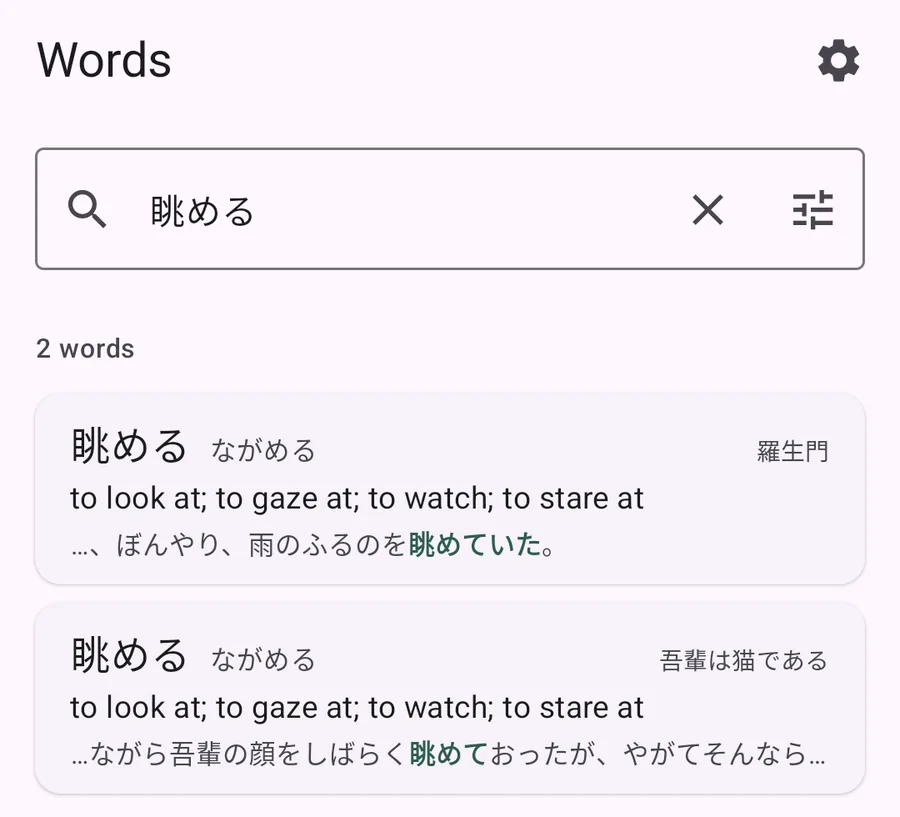
Make a collection for the story and save words with + as you read. 眺める comes up three times here. Save it the first time; when it comes back, in this story or another book, the popup marks it Saved 1×, and one tap shows the sentence you saved it with. The immersion reading guide covers the whole method.